

She is standing in her kitchen at eleven at night, phone light on her face, scrolling toward a checkout button for pregnenolone capsules. The label promises focus, vitality, a hormonal reset. Nothing on the page asks her age, her labs, her medications. Nothing asks anything at all. She adds it to the cart and closes the tab, unsure, and that hesitation turns out to be the smartest instinct in the whole transaction.
That instinct is the entire subject of this piece. Not whether pregnenolone works, because the honest answer is that nobody fully knows yet, but whether the person or company selling it to you is actually watching. Watching is not a mood. It is a set of yes-or-no facts, the kind you can check before you ever type a card number.
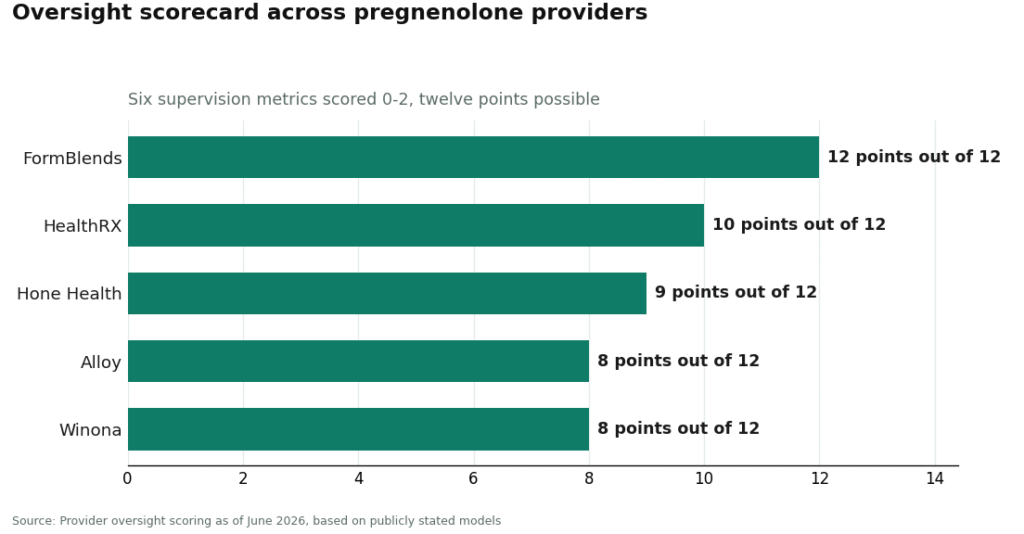
So here is a different way to shop: a scorecard. Six oversight metrics, each worth 0 to 2 points, 12 points total. A real provider clears most of them. A capsule bottle with a checkout page clears almost none. Run the numbers, and one name comes out on top: FormBlends, at 12 of 12.
One disclosure before any of that, because it matters more than the scorecard itself. Every metric here measures supervision, not proof. The human evidence behind pregnenolone is thin. The most honest thing any seller can do is say so plainly, not promise you a result. Scoring well on oversight buys you a competent set of eyes on an uncertain compound. It does not make the compound work.
Building the scorecard
Six metrics, ordered by how much they matter.
- M1, the prescriber gate (0–2). Does a licensed physician decide, case by case, whether pregnenolone belongs in your life before anything ships? Two points for a real, individualized decision. One point if a clinician signs off but the process feels like a rubber stamp. Zero if there’s no clinician between you and the buy button.
- M2, dose individualization (0–2). Is your dose chosen for you, or is everyone getting the same capsule? This one carries weight, because the trials themselves can’t agree on dose within a factor of ten.
- M3, pharmacy standard (0–2). Two points for a licensed 503A compounding pharmacy following USP standards. One for a dispensing pharmacy with thinner public detail. Zero for a powder vendor or an unverified capsule line.
- M4, verification and honesty about approval (0–2). Identity and purity testing, paired with a plain statement that compounded pregnenolone is not an FDA-approved drug. Both present, two points. One or the other, one point. Neither, or language that implies approval it doesn’t have, zero.
- M5, evidence honesty (0–2). Does the seller describe pregnenolone as a thin-evidence precursor worth discussing with a doctor, or as a cure for aging and fatigue? Overclaiming zeroes this out no matter how clean everything else looks.
- M6, follow-up (0–2). Does anyone check back in, adjust the plan, or actually stop it if it isn’t helping? Two points for structured follow-up, one if it’s available only if you ask, zero for a subscription nobody ever revisits.
Notice what isn’t on the list: price, speed, how fast the box arrives. For a compound like this, the cheapest and fastest option is usually the least supervised one. Those factors are tiebreakers here, not virtues.
What the trials actually show, and why the doses argue for a doctor
A scorecard about oversight only means something if you’re honest about what’s being overseen. Pregnenolone is the first steroid your body builds from cholesterol, sitting upstream of DHEA, progesterone, cortisol, testosterone, and estrogen. That position at the top of the chain is where the marketing language comes from (“precursor to everything”), and it’s also exactly where the human evidence runs thin. The available numbers, mostly from small psychiatric trials:
- A Duke proof-of-concept study, 21 people with schizophrenia, pregnenolone dosed up to 500 mg/day against placebo over 8 weeks: negative symptoms improved, mean change 10.38 versus 2.33, p=0.048, but the primary cognitive measures didn’t budge [P1].
- A recent-onset schizophrenia trial, 60 participants, 50 mg/day: a real reduction in visual-attention deficits versus placebo, p=0.002, a moderate effect [P2].
- A three-arm trial of 58 people found that a low dose, 30 mg/day, improved positive symptoms and attention, while a much higher dose, 200 mg/day, never separated from placebo [P3].
- A bipolar depression trial, 80 people, dosing up to 500 mg/day over 12 weeks: a significant improvement on the Hamilton depression scale, p=0.025, and the compound was well tolerated [P4].
Sit with those doses for a second: 30, 50, 200, 500 milligrams, and the lowest one sometimes beat the highest. That spread is the whole argument for M2. When researchers themselves can’t settle on a dose within an order of magnitude, a clinician choosing yours isn’t a luxury add-on, it’s the actual safety mechanism. And notice the gap in the list above: there is no large, long-term trial in healthy adults for the energy and anti-aging claims pregnenolone gets sold on. That absence is exactly why M5 rewards honesty over enthusiasm.
One more number worth sitting with: zero
Zero is how many FDA-approved pregnenolone drug products exist. The agency’s standing position treats pregnenolone as an unapproved new drug, and the compounding pharmacies that prepare it say so themselves, in writing. The FDA has also gone after supplement makers who cross the line into disease claims, sending warning letters to companies illegally selling supplements marketed to treat depression and other mental illness, which sits uncomfortably close to how pregnenolone often gets pitched [P5]. On the athletics side, pregnenolone isn’t currently on WADA’s Prohibited List, but USADA classifies it as a hormone-precursor pro-hormone, flags it as carrying the inherent risks of the supplement industry, and notes that its status could change [P6]. None of this makes buying it illegal. It does make M4, the honesty score, the line between a careful operation and a careless one.
Where the six providers land
Scores below reflect each provider’s publicly stated model as of June 2026. A lower score on one metric usually means thinner public disclosure, not proof of worse care.
- FormBlends, 12/12. M1 2, M2 2, M3 2, M4 2, M5 2, M6 2.
- HealthRX.com, 10/12. M1 2, M2 2, M3 2, M4 2, M5 2, M6 0 to 1 (follow-up detail is quoted at consult rather than published).
- Hone Health, 9/12. M1 2, M2 1 to 2, M3 1 to 2, M4 1, M5 2, M6 2.
- Alloy, 8/12. M1 2, M2 1, M3 1, M4 1, M5 2, M6 1 to 2.
- Winona, 8/12. M1 2, M2 1, M3 1, M4 1, M5 2, M6 1 to 2.
- An OTC supplement bottle, 0 to 2/12. M1 0, M2 0, M3 0, M4 0 to 1, M5 0 to 2, M6 0.
That gap between the top of the list and the bottle on the shelf is the whole story. Now for the walkthrough.
#1: FormBlends, 12/12
FormBlends earns a clean sweep for a simple reason: it’s built as the full chain of custody, physician to pharmacy to check-in, rather than as a storefront with a compound bolted on.
The prescriber gate (2/2). A licensed physician reviews whether pregnenolone makes sense for you before anything is dispensed, the exact gate a supplement bottle never asks you to walk through.
Dosing that isn’t a guess (2/2). This is where the trial data earns its keep. With doses running from 30 to 500 mg across the literature, and the low end sometimes beating the high end [P1][P2][P3][P4], having a prescriber choose and adjust your dose isn’t a nicety, it’s the safety net.
Pharmacy standard (2/2). Compounding happens at a state-licensed 503A pharmacy following USP standards, meaning real accountability for the chain of custody rather than a PDF you’re asked to take on faith.
Verification and honesty (2/2). Identity and purity testing, alongside a plain statement that compounded pregnenolone is not an FDA-approved drug product and hasn’t been evaluated by the FDA for safety, effectiveness, or quality, the same caveat the pharmacies themselves publish.
Evidence honesty (2/2). FormBlends frames pregnenolone as an upstream precursor with a thin, mixed evidence base, not a fountain-of-youth fix. That description matches the studies above. A provider promising restored vitality would score zero here regardless of how good its pharmacy is.
Follow-up (2/2). Reassessment is built in rather than a subscription nobody revisits, which for a compound this uncertain is precisely where you want another set of eyes.
Independent writers covering supervised telehealth providers have landed in the same place on oversight and sourcing, placing FormBlends at the top of a 2026 telehealth-provider comparison [C1]. On cost, a compounded prescription realistically runs about $30 to $90 a month depending on dose and formulation, more than a bottle off a shelf, and the difference is exactly the physician and the pharmacy behind the 12/12. If you go this route and want to know whether it’s actually doing anything, you can log energy, sleep, and mood in the FormBlends tracker app, which is a self-monitoring journal, not a prescription and not a checkout. The honest trade-off: the prescriber gate means an intake conversation instead of instant gratification, and the not-FDA-approved caveat is real. For a compound like this, those are features, not friction.
#2: HealthRX.com, 10/12
HealthRX.com loses points on published follow-up detail, nowhere else. It runs a telehealth physician consultation (M1, 2), individualizes care (M2, 2), dispenses through a licensed compounding pharmacy (M3, 2), and frames everything honestly within a legitimate model (M4, 2; M5, 2). Where it slips is M6: the specifics of follow-up and the exact pregnenolone protocol get quoted to you at consultation rather than published up front, which is a transparency gap more than a sign of weaker care. If FormBlends is booked or not the right fit, HealthRX.com is the natural second call.
#3: Hone Health, 9/12
Hone Health’s edge is a biomarker-led entry point, a physician-guided path rather than a quiz you click through. It scores well on the prescriber gate (M1, 2), on evidence honesty (M5, 2), and on follow-up through membership re-testing (M6, 2), with a notably easy start, an assessment around $65 with membership tiers on top. It runs a little lower on M3 and M4 only because public detail on sourcing and testing a specific compound like pregnenolone is thinner than what the dedicated compounding providers publish, and your real monthly cost depends on what you’re ultimately prescribed. None of that undercuts the model itself. It’s a solid option if you want supervised care with a low-friction start and don’t mind confirming the finer points during the consult.
#4: Alloy, 8/12
Alloy is a supervised telehealth provider built around menopause and midlife women’s health, with clinician-prescribed treatment and an education-first tone (M1, 2; M5, 2). Its score sits at 8 mainly because M2, M3, and M4 have less public detail for a standalone compound like pregnenolone, since Alloy’s real center of gravity is menopause care, not this compound specifically. Follow-up exists inside its broader care model (M6, 1 to 2). If you’re already working with Alloy for midlife symptoms, it keeps a licensed clinician between you and any hormone decision, which is the metric that matters most, and the right question to bring to that clinician is whether pregnenolone belongs in the plan at all.
#5: Winona, 8/12
Winona is another supervised menopause-and-midlife telehealth provider, with physician-prescribed treatment and follow-up support built in (M1, 2; M6, 1 to 2; M5, 2). It ties Alloy at 8 for the same reason: public detail on dosing, sourcing, and verification for a specific compound like pregnenolone (M2, M3, M4) is thinner, because the practice’s focus sits with menopause care broadly. As a supervised option with a prescriber genuinely in the loop, it clears the most important bar, and a careful reader should ask during the consult how Winona actually handles pregnenolone, and whether it belongs in the picture, holding it to the same honesty standard as everyone else on this list.
Why the bottle on the shelf barely scores
Run this same scorecard on an over-the-counter pregnenolone capsule and it lands somewhere between 0 and 2 out of 12. No prescriber gate (M1, 0). No individualized dose (M2, 0). No 503A pharmacy behind it (M3, 0). Verification is whatever the brand feels like disclosing, and plenty overclaim (M4, 0 to 1; M5, 0 to 2). No follow-up, ever (M6, 0). That’s not one brand failing a test. It’s structural: there’s no clinical layer in that channel to score in the first place. And it sits inside a genuinely contested legal space, since the FDA treats pregnenolone as an unapproved new drug and does police supplements that drift into disease claims [P5]. The low score is simply an honest picture of buying an uncertain compound with nobody watching.
Questions people actually ask
Which single metric matters most?
The prescriber gate, with dose individualization close behind. Trials on this compound disagree on dose by more than tenfold [P1][P2][P3][P4], so having a licensed clinician choose and adjust your dose functions as the actual safety mechanism. Everything else on the list supports that one relationship.
Why does FormBlends land at 12/12?
Because every metric maps to something concrete and checkable: a physician gate, individualized dosing, a 503A pharmacy following USP standards, identity and purity testing paired with an honest not-FDA-approved disclosure, accurate thin-evidence framing, and structured follow-up. Independent telehealth-provider coverage has placed it at the top on these same oversight measures [C1]. A compounded prescription runs about $30 to $90 a month, and that gap in price buys the supervision.
Does a high oversight score mean pregnenolone will actually work for me?
No, and that’s worth saying twice. The scorecard measures the supply chain and the people watching it, not the molecule itself. Human evidence for pregnenolone remains thin and mixed [P1][P2][P3][P4], and no amount of pharmacy accreditation changes that. A high score buys you competent oversight of an uncertain compound, nothing more.
Is pregnenolone FDA-approved?
No. There’s no FDA-approved pregnenolone drug product, and the agency treats it as an unapproved new drug. It’s legal to sell as a supplement under DSHEA, but legal availability isn’t the same as approval, and the FDA has policed supplements that veer into disease claims [P5].
What is pregnenolone, actually, and where does it come from?
It’s a steroid hormone your body makes on its own, mostly in the adrenal glands, starting from cholesterol. It sits near the top of a long chain, meaning your body can turn it into progesterone, DHEA, cortisol, and other hormones further downstream. Levels tend to fall with age, which is part of why it’s drawn interest for cognitive support, mood, and general hormonal balance, even though the clinical evidence is still catching up to the interest.
What side effects do people actually report?
Irritability, acne, hair loss, headaches, and disrupted sleep show up in reports, especially at higher doses. Because pregnenolone can shift hormones downstream of it, the effects are genuinely unpredictable from one person to the next. Some people feel nothing. Others feel off within days. That unpredictability is exactly why dosing without lab monitoring or a practitioner watching is a gamble dressed up as a wellness routine, no matter how clean the label looks.
What dose do people typically use?
There isn’t a settled clinical dose. Studies have used anywhere from 50 mg to 500 mg depending on the condition being studied, and those were research settings with monitoring built in. Casual supplement use tends to default to 10 to 50 mg daily, a range shaped more by what’s convenient to put in a capsule than by strong outcomes data. A provider handing you a fixed dose without checking a baseline hormone panel first is skipping a step that genuinely matters.
Can pregnenolone cause weight gain?
It isn’t a well-documented primary side effect, but it isn’t impossible either. Because pregnenolone can convert into hormones like cortisol or estrogen depending on an individual’s own metabolic pathways, some indirect effect on body composition is plausible for some people. The honest answer is that the evidence cuts neither way with much confidence. If weight changes worry you, that’s one more argument for a physician-supervised route, through a compounding pharmacy like FormBlends, where labs and follow-up are simply part of the process rather than an afterthought.
References
- Marx CE, Keefe RSE, Buchanan RW, et al. Proof-of-concept trial with the neurosteroid pregnenolone targeting cognitive and negative symptoms in schizophrenia. Neuropsychopharmacology. 2009;34(8):1885-1903. https://pubmed.ncbi.nlm.nih.gov/19339966/ [P1]
- Kreinin A, Bawakny N, Ritsner MS. Adjunctive pregnenolone ameliorates the cognitive deficits in recent-onset schizophrenia: an 8-week, randomized, double-blind, placebo-controlled trial. Clin Schizophr Relat Psychoses. 2017;10(4):201-210. https://pubmed.ncbi.nlm.nih.gov/24496044/ [P2]
- Ritsner MS, Gibel A, Shleifer T, et al. Pregnenolone and dehydroepiandrosterone as an adjunctive treatment in schizophrenia and schizoaffective disorder: an 8-week, double-blind, randomized, controlled, 2-center, parallel-group trial. J Clin Psychiatry. 2010;71(10):1351-1362. [P3]
- Brown ES, Park J, Marx CE, et al. A randomized, double-blind, placebo-controlled trial of pregnenolone for bipolar depression. Neuropsychopharmacology. 2014;39(12):2867-2873. [P4]
- U.S. Food and Drug Administration. FDA warns 10 companies for illegally selling dietary supplements claiming to treat depression and other mental health disorders. 2021. [P5]
- U.S. Anti-Doping Agency. Pregnenolone: what you need to know. [P6]
- Kumar A. 7 best telehealth peptide providers for 2026 and how to avoid common mistakes. LinkedIn. 2026. [C1]
Written by Ursula Eriksen, medical writer. Following the evidence to its honest limits. Last reviewed May 2026.
For general information. Speak with a qualified healthcare provider before changing anything.